|
A Brief History of the Congregation
Jews, most of them immigrants from
Lithuania, began settling in Pocomoke City and other nearby parts of the
lower Delmarva Peninsula in the 1870s and early 1880s as merchants and peddlers.
These early Jewish settlers were observant and adhered to kashruth, but
they had no rabbi or chazzan (cantor) to lead services and had to travel
to Baltimore and Philadelphia to obtain kosher meats.
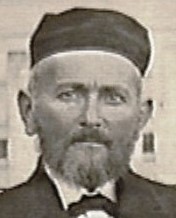
The congregation’s first spiritual leader was Faivel Heilig, a chazzan
and schochet (ritual slaughterer) who lived in Uzventis, Lithuania before
coming to the U.S. around 1900. In 1901, his niece, Rebecca Finkelstein,
who had been living in Pocomoke City since about 1887, convinced him to
move there to become the spiritual leader of the growing Jewish population.
The Orthodox congregation met for many years in worshippers’ homes, lodge
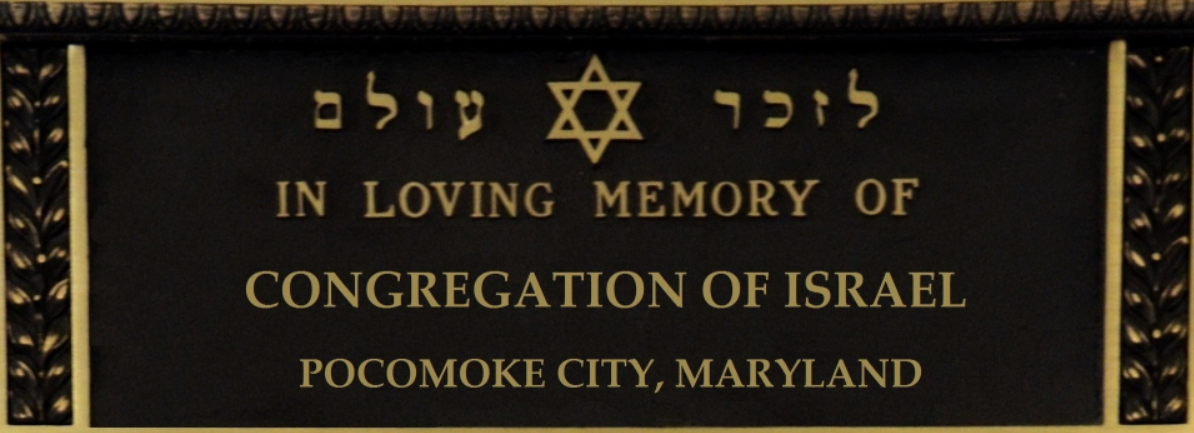
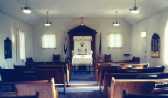
halls, a fire station and above stores. On Dec. 12, 1948, the Congregation
of Israel dedicated its 2,000-square-foot new synagogue on Third Street.
It was the first permanent synagogue structure on the Delmarva Peninsula.
Many of its congregants came from nearby towns such as Snow Hill, Princess
Anne, Berlin and Crisfield, as well as Virginia’s Eastern Shore. The congregation
was now Conservative, but expressed much of its Orthodox heritage.
An estimated 80 worshippers attended weekly and High Holiday services there
in the late 1940s and 1950s. Until the mid-1950s, the congregation
had a full-time rabbi.
As Jewish children grew up and left town and the older Jews died, the congregation’s
numbers began to decline and a rabbi became an unaffordable luxury.
Congregation of Israel then discontinued the weekly Shabbat services, but
the congregation arranged with the rabbi from Salisbury to come to Pocomoke
City on Wednesday evenings to conduct a weekly prayer service, religious
school class and study session. For the High Holidays, the congregation hired
rabbis from various yeshivot and seminaries to conduct services.
Eventually the declining Pocomoke Jewish population could no longer support
the Wednesday services but, with the leadership of a couple members (one
of them the husband of a granddaughter of Faivel Heilig), the High Holiday
services continued. After the deaths of those two men in 1996-1997,
a son of each assumed their roles of maintaining the synagogue and arranging
for rabbis to lead the services for Rosh Hashanah and Yom Kippur.
In 1998, significant renovations made the building a more comfortable place
for those attending those services. Some Jewish families returning to their
ancestral hometown for those services, bolstered by a few other families
who later moved to the region, joined with the few remaining Jewish residents
to form a core group that sustained the yearly gatherings.
In January 2009, one of the two men sustaining the synagogue’s operation
moved to Washington State to be nearer to his grandchildren. His roles
of financial manager, rabbi coordinator, repairman, gabbai and shofar-blower
were more than could be assumed by the one remaining. With great reluctance,
the two decided to cease operation of the synagogue.
|
|